





Understanding the WaypointAds Rate Card
The WaypointAds Rate Card uses a simple internal value system to price the advertising opportunities you make available. WaypointAds calls these values Tokens, but your advertisers don't necessarily need to see them that way.
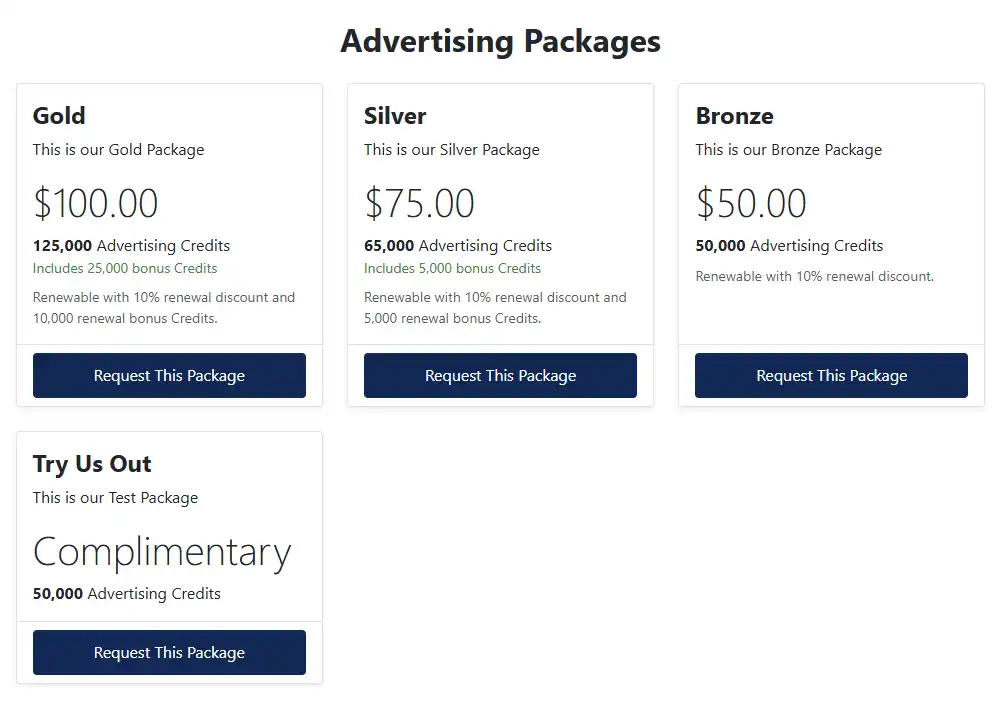
You can present them as Tokens, Credits, Points, Ad Credits, or simply use the currency familiar to your customers. If you prefer dollars, pounds, shekels, francs, or another currency, the values can be treated one for one.
WaypointAds handles the numbers. You decide what they're called.
What Are Tokens?
A Token is simply a unit of advertising value within WaypointAds.
Internally, WaypointAds needs a consistent way to measure the value of advertising opportunities. We call that unit a Token. What the Administrator chooses to call it when presenting the Rate Card to advertisers is entirely up to them.
You can use Tokens, Credits, Points, Ad Credits, or terminology that fits naturally with your website. You can even present the values as ordinary currency.
Prefer Dollars, Pounds, or Another Currency?
That's perfectly fine.
If you would rather your advertisers see familiar monetary values, there is no need to invent a complicated conversion system. Simply treat the values one for one.
If an advertising opportunity is worth 50 Tokens internally, you might present it as:
$50
£50
₪50
₣50
In each case, 50 means 50. There is no conversion table for the Administrator to maintain and no mental arithmetic for the advertiser to perform.
WaypointAds doesn't need to make advertising economics more complicated than they already are.
Keep It Simple for the Advertiser
The Rate Card should be immediately understandable from the advertiser's side of the screen.
If your customers are accustomed to seeing prices in dollars, there may be little reason to ask them to think in Tokens. Show them dollars. If a credit-based system better suits your advertising model, use Credits or Tokens instead.
WaypointAds provides the mechanism; the Administrator decides how that value is presented.
The goal isn't to create a miniature banking system. It's to sell advertising.
Why Use an Internal Value at All?
Because it gives WaypointAds a consistent way to understand the relative value of the advertising opportunities you create without dictating how those values must be presented to your customers.
Suppose one advertising opportunity has a value of 25 and another has a value of 50. Internally, WaypointAds can work with those values consistently. On one website, the advertiser might see 25 Tokens and 50 Tokens. On another, they might see $25 and $50. Another Administrator might call them 25 Credits and 50 Credits.
The underlying relationship doesn't change.
This gives the Administrator flexibility to introduce new Zones, packages, and advertising opportunities while maintaining a simple and consistent system of value. WaypointAds doesn't need to decide what your advertising is worth or what you should call your money. It simply provides the mechanism for managing it.
Why Should Different Zones Have Different Values?
Because all advertising locations are not equal.
A prominent advertisement near the top of a heavily visited page is likely to receive considerably more attention than an advertisement farther down the page or in a less frequently visited section of the website.
The physical size of a Zone can matter as well. A large, highly visible advertisement may reasonably carry greater value than a smaller position. Placement, visibility, expected traffic, page importance, and the number of advertisements competing for attention can all influence what an advertising position is worth.
Think about traditional advertising. A billboard beside a busy highway does not normally cost the same as a small sign beside a quiet country road. Both are advertising spaces, but the potential audience and exposure are very different.
The same principle applies online.
Page Header Zone might therefore carry a higher value than a smaller or less prominent Zone. Another Zone appearing throughout many pages of the website might be valued differently from one appearing only within a specialized section.
There is no universal formula that says one Zone must be worth twice as much as another. You know your website and its audience. WaypointAds gives you the ability to reflect those differences when establishing your advertising opportunities.
We will discuss Zones themselves in greater detail separately. For the Rate Card, the important point is simply that different advertising locations can represent different amounts of advertising value.
Creating a Rate Card That Makes Sense
The Rate Card should be understandable from the advertiser's side of the screen.
Whether your advertiser sees Tokens, Credits, Points, or familiar currency, they should be able to understand what their money can buy and why one opportunity may cost more than another.
There is no advantage in creating an elaborate pricing system that requires a calculator, three spreadsheets, and an economics degree to understand.
Keep the relationship sensible.
If your most desirable advertising location is clearly more valuable than another, its price or value should reflect that. If two advertising opportunities provide roughly comparable exposure, wildly different values may be difficult to justify.
The goal isn't to make the system complicated. It is to give the Administrator a flexible way to establish value while giving advertisers understandable choices.
A Flexible System Gives You Room to Grow
One of the advantages of using a consistent internal value is that the advertising system can grow with the website.
New Zones can be introduced. Existing advertising positions can become more valuable as traffic increases. Different packages can be created for different types of advertisers, and promotional opportunities can be offered without restructuring everything else.
The internal value remains the common unit connecting those opportunities, regardless of whether your advertisers see Tokens, Credits, Points, dollars, pounds, or something else entirely.
The Administrator knows the relative value assigned to each advertising opportunity. The advertiser sees a Rate Card expressed in terms they immediately understand. WaypointAds handles the relationship between them.
The Rate Card Is Your Advertising Shop Window
The Rate Card is more than a price list.
It is where the advertising opportunities you have created begin to look like something a customer can actually buy.
Your Zones determine where advertisements can appear. Their values help establish what those locations are worth. The Rate Card gives advertisers a straightforward way to purchase that value and decide how they want to use it.
Keep the Rate Card clear, keep the values sensible, and remember that the person looking at it may be seeing your advertising opportunities for the first time.
If they can quickly understand what they can buy, what it costs, and why one opportunity is worth more than another, the Rate Card is doing its job.
